Custom Search

Thursday, May 01, 2008

Tarpeian Rock and Capitoline Museum

Beyond the Roman Forum's final arch, the pathway climbs the Capitoline hill. The Capitoline Museum is housed in 2 separate buildings, sitting across from each other on the Piazza del Campidoglio. As usual, wikipedia has an informative article, with more pictures here The museum houses primarily statues. The main thing to remember is, should you ever visit, despite the fact that there are 2 buildings, with nothing noticeable connecting them, you do not leave the first to enter the second. Instead, you must take the stairwell down, and follow an underground tunnel to connect. If you try to enter the second museum through the exit, you will only be turned away with vague pointing at the first museum, and no explanation of the mystery of reaching building 1 from building 2 when they clearly do not connect.

Upon first entering the main museum entrance, you are met with the broken pieces of a once giant statue


It is of some note that, having been palaces, the museums are quite beatiful in and of themselves.


The works of the museum are primarily statues, though there are a few notable paintings as well, including a painting by Caravaggio of St. John the Baptist, and The Rape of the Sabine Women by Pietro da Cortona


There is a nice statue of Hercules, who is easily identifible by the club, the golden apples, and the skin, all representing the labors of Hercules. As an interesting side not, Hercules is actually the Roman name for Heracles, though this name is often used in modern times in conjuntion with the Greek names of gods, such as Aries and Aphrodite, rather than the Roman counterparts, such as Mars and Venus.


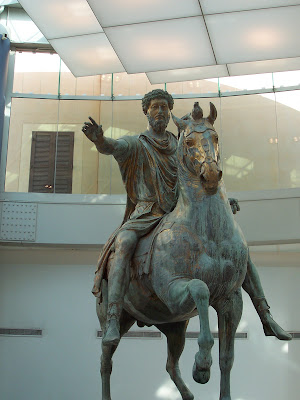
In another section of the museum stands the original statue of Marcus Aurelius astride a horse, which used to stand in the courtyard between the palaces. The statue is larger than life, and still bears remnants of its gold covering, over the bronze.


Among my favorites is the Capitoline Venus. The details of the body on this statue are incredibly realistic.


My absolute favorite is the Dying Gaul. This piece stands our sharply from the traditional statues of gods and emporers, and depicts a defeated Gaul in the moment of death. The extreme detail of this statue is captivating. Veins are visible in the hands and legs, the foot with curled toes leaves wrinkles on the underside of the foot, and in all aspects excepting the stylized wound and blood are so realistic as to have the details of an actual person.


There are many many more statues in the museums, here are photos of just a few, including a child (probably Hercules) playing with a snake, a rather disturbing cherubic faced adult Hercules, a statue using the natural colored marble to mimic the bruised body of a saint, as well as some wonderful examples of the detail given to hair and fabric in the sculptures throughout the museums.


And a final picture of that elusive underground passageway connecting the 2 museums


After spending a great deal of time at the museum, we emerged back into the sunlight, and head for a quick view from the Tarpeian rock, which is back towards the path down to the forum, but to the left. From this rock were thrown traitors and the physically deformed. Today, it affords a nice view of much of the excavated ancient Rome. From this point we wound our way back through the forum, this time taking advantage of the free flowing fountains, and finally returned to our car, ready to rest our feet by taking a drive south to the town of Arpino.

Tuesday, April 15, 2008

CA 06: Deserts all Day

Our wild night driving into the campground at the Mohave National Park, we woke up about 6:30 am, to the sound of rain on the roof of the car. Outside, the rocky desert scrub landscape was a dark wet brown. I got out of the car, startling a jack rabbit, and inhaled the pervading scent of wet lumber. The campground was a grove of pinion pine that had burnt a few years ago. The smell was pungent, and somewhat unpleasant, having something of the smell of railroad ties. There were all different kinds of flowers blooming everywhere, and I scampered about taking up close photos of all the different ones I saw. The drizzle dwindled into nothing, as we stretched out and got ready to go. We went to the visitors center which was still closed, and explored some of the craggy rock formations around it. We then headed on an exploratory mission through the park. At one point we spotted what we believe was a peregrine falcon, sitting on a lonely outcropping of rock. All along the road were small clusters of quail rushing through the brush.

Finally we left the park, and headed for another kind of desert: Death Valley. It seems to take forever to really get down into the valley. The two land highway winds through a dry wasteland of rocky hills, reminding me more of footage of Afghanistan than any American landscape. Finally, as we crested a hill, we could see down into the valley. Something like 1200 ft in elevation later, we were approaching the lowest point. We stopped to investigate the ruins of Ashford Mill, and felt the dry heat cracking in the afternoon air. We got back in the car, and continued on towards bad water, remaining below sea level. Ahead of us on the left, a broad flat white plain came into view. Further ahead, there was a large lake - err wait, no, that's not really water... is it? No, no way, but... it looks like water. In fact, it look like a lot of water. We drove all the way to bad water without ever reaching that mirage, of course. At bad water, we were officially 282 feet below sea level. We walked a little bit of the way out onto the salt flat, but even though the temperatures that day were not as high as they could have been, the dryness of the air made it very uncomfortable. Further down the road we took a detour to see the artists palette, a section of the hillside that is many colors due to the different minerals in the rock. We missed Dante's view, and the racetrack, because time was short, and the day was getting long. It was time for us to make the long drive out of the park, and head towards out destination for the next day, Sequoia and Kings Canyon National Park. The drive was uneventful, and unhindered by lunatic rabbits.

Wednesday, April 09, 2008

Arch of Constantine


Near dawn on our second day in Italy, we woke in our little tent and packed up our even smaller car. We headed back into the heart of Rome, heading straight for one of the city's best known buildings. Known in English as the Colosseum, but known in Italy as the Coliseo, This massive structure rivals today's sporting event structures in size, and is the model upon which they are often built. Much of the outer walls are gone, victims of time and earthquakes, but what does remained is shored up by angled brick sections.

We easily found a parking spot nearby and wandered the almost deserted streets. 8am in Rome is like 7am here. No one is out but the shop keepers setting up. Our goal on this particular day was not to actually pay a visit to the Coliseo, but to see the less famous arch that sits right before it, the Arch of Constantine, before we crossed through the Roman Forum to reach the Capitoline Museum.

The Arch of Constantine is one of several arches in the area of the Roman Forum, and, having been built around 315 AD was the last one built. It's purpose is to Commemorate Constantine's defeat of Maxentius. Many of the pieces of the arch were thought to be taken from existing structures or ruins, and re purposed to represent the battle. For a good description and more pictures, check out wikipedia's entry.


After looking over the arch for a while, we headed off through the Roman forum, which we would spend more time exploring another day. The forum is a large area filled with many ruins in varying degrees of decay. As a city center is houses temples to roman gods as well as early christian cathedrals. It was deserted in the early morning, and following the ancient road through it toward the Capitoline Hill, we were surprised to encounter free flowing drinking fountains, which seem to belong with the ruins. We weren't sure at the time if they were truly for drinking, but later, in the heat of the day and tourists everywhere, they were surrounded by thirsty people with cupped
hands or empty bottles.


Stay tuned for the Tarpeian Rock and Capitoline Museum.

Tuesday, April 08, 2008

Greatest Show on Earth Might Be Overstating it.

I was really excited to be going to a Ringling Brother's Circus, and a Barnum and Bailey Circus. I'm still a little confused that these are now the same thing. When Bellowbration came into town, it was high on my list of priorities, since I had skipped it last year to see Cats instead.

Overall, I had a good time, but several things made the experience less fun. The cost of the tickets I could understand, given the big names involved. But the mark up on the cheap toys being sold were offensive to me, though many of the parents didn't seem to mind shelling out $20 for a whirligig, which sells for $5 at Wal-mart. But I can get past the price.

I supposed what disappointed me was that the circus has made an attempt to modernize itself, using nickelodeon like characters, and a large screen for many parts of the show, the old fashioned show is gone. I don't think I'll being going to a circus like this again. I much prefer the more basic Ronald McDonald circus, which has all the same circus tricks with less of the modern add ons.

Thursday, April 03, 2008

An Italian Experience from an American Perspective: Day 1

First let me say, that there were problems with my tickets. I had gotten the tickets in my married name, and forgotten that the passport was in my maiden name. This was no problem said the man in Nashville. He changed my name and gave me paper tickets. But, he didn't give Jake paper tickets, and somehow, his e-tickets got assigned a new number. So when we landed in Amsterdam at 5am, we had to wait at the ticket counter to get Jake's boarding passes, and they had trouble finding them in the system. Finally, they figured it out, and we ran to the complete other side of the airport to make our flight. We arrived in time and boarded the plane.

When we finally touched down at the Fiumicino airport just outside of Rome, I was happy to find that getting our car went much more smoothly than the tickets had. The fellow there showed us the car, and we were on our way.

The car was a SMART car, a tiny 2 seater that got phenomenal gas mileage. I had done some careful research online to determine if a) there would be leg room for Jake and b) we could store our luggage. Ultimately, we decided that Jake would fit just fine, but we needed to pack light, so we took 2 large duffel bags and 2 backpacks, rather than suitcases which couldn't be packed down or squeezed the same as the duffel's. Everything fit perfectly in the small area behind the 2 seats, underneath which is the car's tiny engine.


Even at $5 per gallon, we only spent a little over $250 on gas while in Italy, despite the fact that we drove just over 2500 miles, or 4000 kilometers. Not only was it great for gas, but its narrow width and short length made it perfect for navigating some of the narrow alley ways we sometimes found ourselves on.


As we left the airport, I pulled out my thick 3 ring binder full of info and directions, as well as the detailed Michelin highway map of Italy, and we were on our way. Our first stop was Ostia Antica just a short distance from the airport. We found the location easily and pulled into the gravel lot. After paying for parking, and for entrance (parking is rarely free in Europe, no matter where you go) we walked into the ancient city, and found that here, as we would see so many other places throughout the country, there were stray dogs. The prime suspect here was sleeping casually in the shade in the middle of the ancient road, with no regard for the few tourists. Due to jet lag, combined with the vast area covered by the ruins, we truly saw very little of this special place, before our weariness led us back to the car. Our next destination was in downtown Rome.

Little can prepare you for driving in Italy. Their interstates (the autostrasse) crisscross the country, and our much like ours. Highways, I had read, and expected, were slightly different. Cars would pass on a 2 lane road, even with oncoming traffic. The 2 other cars were expected to straddle the white lines, while the passing car passes straddling the center yellow line. That, I could handle. What I was completely unprepared for was the way the basic street system degenerates when in the core of the larger cities. Rome, is not the worst in this case. I would say Palermo on Sicily easily wins the award, but this was our very first day of driving.

Once into the downtown area, there are only a few rules:
- stay on your side of the road
- do not run red lights
- do not f with the bus. the bus will kill you. stay out of its way.
- scooters win.

As the highway we took into town degenerated into a city street, I suddenly felt like we were in one of those euro racing games. the lines on the road, except the center line disappeared. Scooters darted between cars with a reckless disregard for their lives, or the fact that we were driving a rental. The cars formed as many lanes as they could fit across the width of the road. buses stay generally to the right, and after dropping off passengers, would pull into traffic with little regard for the lives of others. We lined up at the red light, with scooters moving between the cars, and pulling to the front. Sometimes there were more cars lined up than could drive side by side down the road across the intersection. Paying attention and merging were VERY important skills. I'm glad we live in Murfreesboro. The driving here is a degree in the right direction to driving in Italy, but only a degree. We also found that busy intersections which do not have lights function differently than here. Replace the cars and streets with people in very crowded hallways, and you get the right idea. You slowly nudge yourself into the intersection until you are blocking traffic, and then you go, as well as all the cars behind you, until someone from another direction squeezes out, and takes their right of way.

To put it more simply, the flow of traffic is very liquid, and rather than drive defensively, everyone drives offensively. As scary as it is at first, it's a system that seems to work well, though, as Jake will attest, many cars have cracked quarter panels and dinged bumpers.

After some circling around, we managed to find a parking lot centrally located to our downtown destinations. Reading the payment sign we discerned that parking was free on Saturdays. The following morning we would find free parking near the Colosseum. Ironically, of all the parking we paid for, we never paid parking in Rome. A church's doors opened onto the parking lot, and on the stoop slept several homeless people. A nearby wall smelled strongly of urine. Yes, there are many homeless people here, as with any city. We turned first to the Area Sacra Largo Argentina and its ruins. We walked around it, counting kitties, then turned up a side street towards the Pantheon. Along the way, we stopped to photograph an obelisk on the back of an elephant, in front of an otherwise unnotable building. After seeing the Pantheon, on the way back to the main street, we realized the unnotable building was our next destination, Santa Maria Sopra Minerva. Finally, we made our way to Il Gesu. All of these sites are located very close to each other, and the free parking was centrally located to them, making it extra nice. On the way back to our car, we stopped by a grocery and grabbed some chocolate cookies and super cheap water.

After a busy, jet lagged first day, we were ready to drop, so we headed to Plus Camping Roma, where we had reserved a house tent for about $30, super cheap, and just outside of Rome. This camping village has tent houses, camp sites, small cabins, a grocery, and a restaurant, as well as a pool and play ground. It's popular with backpackers. I was dreaming of a tan canvas tent, like they use on safaris, but found instead these small teal colored tents just big enough to hold 2 cots with space to walk in between. Still, the cots were comfortable, and I would stay here again for the cost.


We decided to use our little coupon and head over

to the restaurant on site. Here we had our first authentic wood oven cooked pizza, and I was starving. Unfortunately, I don't like thin crust. But not only is the crust thin, it is also crisp, more like a giant saltine than pizza crust. But my main issue with the pizza in Italy is the sauce. Perhaps they use different spices, or the tomatoes are of a different kind, but something is off. I do not like Italian pizza.

After all that, we fell exhausted into bed. It was the first busy day of 16. Stay Tuned.

Tuesday, March 18, 2008

CA 06: The Zoo, the Desert, and the Rabbit

On the third day of our vacation, we went to the San Diego Zoo for the first half of the day, and then we spent the evening at Joshua Tree National Park.

The San Diego Zoo is very impressive. They have every type of animal you would expect to find in a zoo, including Koala bears, an many more. Many of the animals had or were getting ready to have babies. There were gorilla, orangutan, and chimp babies. An anteater carrying its baby on its back, a young, though not new born, panda, and the flamingos were building mud. The zoos in my area definitely don't have breeding programs like this. We also visited two animal shows. The first featured a sea lion and a timber wolf, but not together! The second show had a bear cat and an Arctic wolf. We all howled until the wolf howled with us, and that is a very sad and eerie sound. My favorite exhibit was probably the chimps, who have an artificial termite mound, so we got to watch them using sticks to eat from it. We did some fast walking and managed to see most of the zoo in 6 hours.

After the zoo we left for Joshua Tree National Park, and arrived on the south side about 5pm. A short walk took us to the Cottonwood spring, where the water was trickling out from among the tall trees to disappear in the sand and rock. We then headed north through the park and stopped to see Cholla Cactus Garden. After that we went to see arch rock, which looks like an elephant. After that Jake went to see skull rock, but my feet hurt too much at this point to make the short walk to see it.

The small town where we came out of the park is called Twenty Nine Palms. There weren't many food options there, so we ordered some Papa Johns, and ate it sitting on the warm pavement in the parking lot behind the place, illuminated by an orange street lamp. It was the best Papa Johns I've had in years, as they still actually load it up with sauce. Then we headed off for the Mohave, thinking that our adventure for the day was done. Little did we know, a rabbit was waiting for us.

We planned to drive into the Mohave, and sleep in the car at a campground there, but by 11:00 pm I was too tired, and made Jake pull to the shoulder to sleep. Unfortunately, the desert is still very hot at that time, so about 12:30, we decided we couldn't sleep in the heat any longer, and decided to continue on to the campground. By this time, the nightlife was out in force. Mice and rats of various sizes scurried off the now gravel road. Jack rabbits were startled and hopped out of our path, all of them that is, except for one. This rabbit, instead of running off the road, ran down the road. So we stopped the car, thinking it would move out of the way. It stopped. We crept forward slowly, it crept forward slowly. We tried stopping and turning off the headlights, because we were in the middle of absolutely nowhere. At this point, it actually returned toward the car. I tried to scare him off the road by getting out of the car and walking down one side, but he persistently stayed in the middle of the road. We were afraid to push him to much, as we didn't want to give him a heart attack, so we finally admitted defeat. We decided to stop and try to get some sleep where we were. The bunny once again approached the car, and finally crossing right in front of the wheel, almost under it, he hopped of onto the shoulder of the road, and after 20 minutes of being delayed by this guy, we were free to go. By the time we reached the campground, temperatures had dropped down to be a little chilly, and we slept much more comfortably, until the rain woke us up in the morning

Friday, March 14, 2008

CA 06: Truly the Happiest Place

Honestly, I went to Disneyland because I felt obligated to see the place that seemed to impress so many. But I've been to theme parks. I've waited in the lines. And the population of the LA area is astronomical, the number of tourists there, far larger. The financially capable juggernaut that is Disney: substantially more evil.

My expectations were low. I assumed the lines would be terrible, and we would be very luck to be able to ride all the rides on my list, even once. I supposed the food costs would be astronomical, in keeping with tomorrow lands theme. I thought the rides would be kitschy and boring and the evening shows would be a disappointment

I have to admit, I was very pleasantly surprised.

We were able to ride all the rides I had written on my list, except one, and we probably would have been able to do that, if I had known what fast pass was prior to waiting an hour to ride Splash Mountain. Not only is the fast pass fantastic (I barely had to wait in line at all after that), but its a free service. They could easily charge an extra buck or two, and being the huge corporation that they are, I expected it. But they don't. Those tickets are free which is simply awesome. If you're wondering, you get ticket from a machine near the ride entrance that tells you to come back between such and such times, and you get into the fast pass line, which was usually empty when I was there, and pass all the people waiting in the regular line. And I'll add that if we had gotten there at the planned 8am, instead of the much delayed 12pm, we could easily have ridden the rides twice.

Food costs were more reasonable than the airport. We ate outside the park, at a little stand by the Disney downtown. Chicken fingers, chili cheese fries, coke. About $10. I was a little surprised at that. We also discovered that they will let you bring food and drink into the park. We hadn't brought our backpack though, anticipating, incorrectly, that this would not be allowed. We chose not to make the hike back to the car, because we were already running late, but this is very good to know.

The rides while kitschy were absolutely wonderful. Splash Mountain tricked me. The jungle cruise entertained me. The Matterhorn was fun, and Space Mountain actually awed me. The haunted house impressed me, and made me laugh. These aren't the fast pace, rip your heart out speeds, loose your stomach drops of modern rides. The roller coasters and other rides are almost leisurely. Jake and I both agree that the themed part of the theme rides is a big part of what makes them great.

The evening shows absolutely did not disappoint. The Fantasmic show by the water was really fun and entertaining. A grin inducing mixture of video, pyrotechnics, costumed character, and a magician like ability to sneak in the scene changes including entire boats. Afterwards we had time to get over to the main street to watch fireworks which were sweet, and dare I say, romantic, despite the massive crowd watching.

Good crowd control is a big part of what keeps Disneyland fun. In addition to the fast pass, when they are having shows, such as Fantasmic or the parade, they rope areas off and help keep pathways open for walking.

Wherever you look while at Disneyland, there's something fun to see, whether it is costumed characters or swing dancers in the evenings, it all comes together to make for a surprisingly great time.

While the entrance cost is somewhat high, it's worth it.

Thursday, March 06, 2008

Il Gesu and Area Sacra Largo Argentina

Located within easy walking distance
of the Pantheon and Santa Maria Sopra Minerva are two more Roman treasures: Il Gesu, the Jesuit Mother Church, and Area Sacra Largo Argentina a collection of ruined temples among more recent city structures.

Il Gesu

Il Gesu stands on
the location of the first Jesuit chapel. When this church was finally built, the catholic church was still struggling in the wake of the protestant reformation. Initially undecorated, the church is now decorated with silver, gold, marble and more.
Il Gesu has a distinctive white facade. exterior is a richly decorated and colorful interior. The ceiling, which is the main reason I chose to visit this church, is elaborately painted with a scene of the glory of Christ. The painting literally bursts from its frame. It is set amidst a ceiling of gold, and surrounded by white sculptures of angels.
Its telling feature are the scrolled pieces known as volutes. Beyond the somber

Area Sacra Largo Argentina

These ruins are little known, even among the abundant amount of information to
be found on the web, despite the fact that they are located so near to other structures of note.

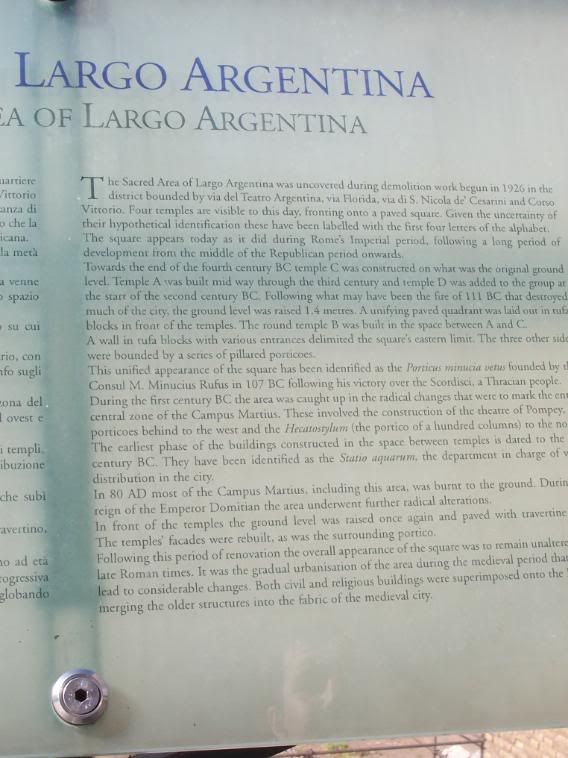
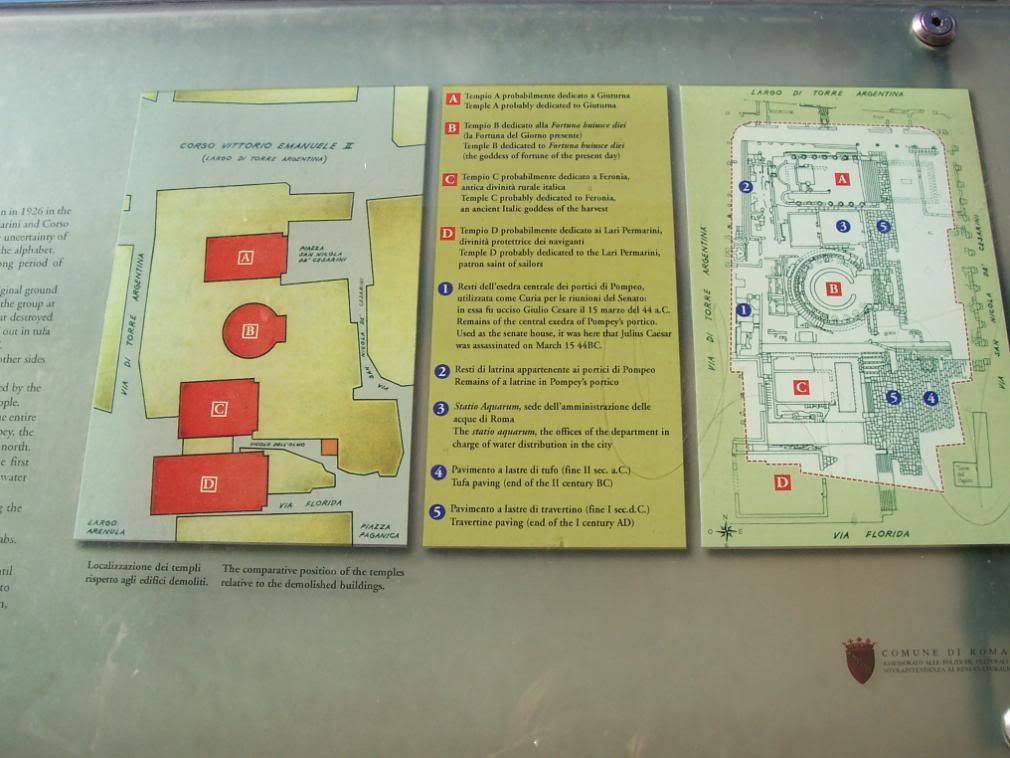
The ruins are located along the Corso Vitorio Emanuele II and consist of 4 temples and their surroundings. The ruins set lower than the modern streets. While it is possible to get a brief tour to walk among the ruins, everything of interest can generally be seen from above. For more detailed information, I took the liberty of photographing the signs around the ruins. There is some historical info, as well as some maps. The ruins are also a cat sanctuary, and the guided tours are billed as supporting the cat population.

You may even be able to make out the lone black cat in my picture, but be assured there are many
cats in every shady spot within the sanctuary.


CA 06: A day at the Beach and more

In 2006 we took a week to explore the southern 2/3 of California. We began in San Francisco, and worked out way south through LA to San Diego, then headed inland to the deserts and mountains as we worked our way north again, finally returning to San Francisco.

After our arrival in San Francisco and driving south out of town the previous night, we woke up ready for our first day in California. Having been born in LA, but moving away at the age of only 1, I was excited to get to know my home state.

We first went to Point Lobos, which has one of only two natural stands of Monterrey Cypress, the other being just across from the point. We were early arrivals and weighted in line for the gates to open, because I had heard the point could become very crowded later in the day. After entering, we parked and headed straight for a trail through the cypress. We immediately saw some quail in one of the trees, along with spectacular views from the cliffs. With our binoculars, we could just make out the sea lions out on their rock, but we could hear them easily. We walked leisurely along the trail that would through the grass beneath the trees. In a cove on the back part of the trail we saw two harbor seals basking on a rock, and a sea otter sleeping in the kelp beds.

After finishing the cypress trail, we walked down the sea lion path, which leads closer to the shore. There we saw more harbor seals including some babies. We saw another sea otter, this one swimming in the crashing waves near the rocky shore, and we got a closer view of the sea lions. There were also some nesting sea gulls, Brandts cormorant, and some brown pelicans to be seen.

After this we proceeded on to a series of beautiful waterfalls and beaches along highway 1. We saw Pfeiffer falls first, which is down a path through a beautiful stand of redwoods. There at the falls was a Stellar Jay being fed by excited children. I had never before realized that jays and crows were closely related, but this bird makes that connection. It moves and behaves like a crow, but has the comb and striking colors of a jay.

We then proceeded to Pfeiffer beach, which, despite being billed as a favorite beach in the area, has a narrow, windy, and poorly paved road leading down to it. But indeed it was an awesome beach. It is a sand beach, which is C shaped around two rock arches, which almost touch, forming an M. The water rushes in through the arches throwing up spray. While we were there we saw some interesting animals. In the rocks among the left side arch we found sea squirts, crabs, and a starfish. There were also some interesting people on the beach. 2 youngish girls in bathing suits screaming whenever they dared to touch their toes to the cold water, surfers protected from the cold by their wet suits, and a couple of naked children, running about. I always heard California was more free.

Following that we went to Julia Pfeiffer Burns SP (I know! Who are these Pfeiffer people?), which has a beautiful waterfall that pours onto the beach. However, you can not actually get down to the falls, but you do get a great view. Here we saw some ground squirrels and a couple more Stellar Jays, as well as a some interesting purple wildflowers. All of the vegetation here is strange, from the trees, to the flowers, even some of the grasses.

From there it was on to Jade Cove. True to its name, there is jade to be found here, and what's more, it's legal to collect. So collect we did, at our own risk. Jake found a pocket of rocks higher up away from the water, but I, after cautiously setting down the backpack, climbed down the rocks right level with the breaking waves. My goal was a small pool of smaller rocks, polished by the crashing waves. I had observed carefully before hand, and was certain none of the waves were coming in that far. After I had collected half a dozen really good specimens, Jake decided to join me. The water apparently liked him more that it liked me. Until he came down, I had only one wave come in far enough to send a wash of water around my feet. As soon as I was joined, however, by him, the waves began to surround my ankles. I was wearing carpi's, so this was OK. Jake, however, was wearing pants. Then a good one came in, with an even bigger one behind it. I, using my fantastic rock climbing abilities, learned in college climbing a wall with mostly 2x4 squares screwed onto it, latched Velcro like, horizontally to the rock behind me. My husband having taken the same class, but, unfortunately, lacking my cat like reflexes, was suddenly up to his knees in water. After that we returned to higher ground to search for rocks.

After the cove, we headed to salmon falls. This waterfall is really fantastic. The photos really cant do justice to its size and beauty. It is nestled down in a small green valley among large some boulders.

Finally, having completed our busy day outdoors, we were ready for something fancy. So we went to Hearst Mansion, where we had tickets for the evening tour. This is a house built when rich people knew what to do with their money. The house is ornate, but the rooms are mostly small and friendly. The best part of the tour was the many costumed people about the house, chatting, playing pool, reading in the library, etc., which is done for the evening tour only. If only my pictures had come out better. Unfortunately, the outdoor pool, which appears in Spartacus, had been drained due to a leak, but, on the upshot, as our guide pointed out, its a unique shot. The indoor pool was really incredible, but didn't photograph that well at all, being even more dimly lit than the rest of the house.

Thus concluded our first of many days of great adventure in California. For more, stay tuned.

Thursday, February 07, 2008

Wheeler: It's for the birds.


The Wheeler National Wildlife Refuge near Decatur Alabama is a great place to see water fowl during the winter. Even this december, after such a terrible drought, there was enough water to attract all kinds of ducks, geese, and even sandhill cranes.

The refuge is disjoint, with different areas and different trails seperated by several highways. For general information on the site, check their website here. Visiting the visitor's center is a must, for maps and information.

At the visitor's center are 2 trails. One leads along a loop begining and ending with a small cypress forest. Durng warmer months, this area is full of small songbirds. Beyond the cypress is a typical southern forest full of lower brushy undergrowth and muscadine vines. The loop does pass by a man made pond with a sheltered area, but though the people on dutey tell us that the birds do frequent this spot, we have never happened upon anything there, aside from some dragon flys and bumble bees in the summer. On the returning portion of the loop is a large stand of bamboo, and a persimmon tree with it's branches hanging low over the path. Once we visited in late summer, and, reading that the fruit was indeed edible, decided to try some. I can strongly recommend against doing this. The taste was extremely bitter, and seemed to instantly and permantently dry out the mouth. We later learned they are not full ripend until the first frost.

The seond of the 2 trails leads to a 2 story bird blind structure overlooking some wetland habitat. In the summer, this area has many common song birds, and the occasional hawk. In the winter, this is the chosen spot to view the wintering sand hill cranes. These lanky birds float like magic through the air to land, one after another, in the midst of the other birds, proceeding to either eat calmly among the cut crop fields, or to bicker with other cranes.

There are other trails throughout the area, each with a slightly different habitat, and accompanyment of birds that shifts throughout the years. Perhaps my favorite feature of this park is the complete lack of a crowd. Having visited in the off season of late summer, we had been expecting more of a crowd in winter, but were pleasantly suprised to find ourselves almost alone in the park.

Friday, February 01, 2008

Pantheon - Concrete Wonder


The Pantheon of Rome, not to be confused with the Parthenon of Athens, is something of an architectural wonder. The current structure was built in 125 AD, after the original structure had been destroyed 40 years earlier. The name means Temple of all the Gods, and was originally used by the Roman's to honor several gods. It is one of the best preserved Roman stuctures, largely because it has been in continuous use since its contruction, becoming a church after Rome's conversion to that faith.

The building itself consists of half of a cube for the bottom, and half of a sphere for the top, such that the full cube would perfectly contain the full sphere. The entryway is sheltered by a protico 3 pillars deep, and very tall. There are no windows,
just a large circular opening, known and the oculus, or great eye in the ceiling. This opening measures 30 feet across, and is the only real reference for size when one looks up into the massive dome. The dome itself is constructed of unreinforced concrete, and is the largest such dome in existence. It is a structure that even today's engineers would have difficulty reproducing, and it is nearly 2000 years old. The coffered ceiling originally had copper stars inside each square, and the roof was once covered in copper as well. Over the years the metal has been stipped from the church, and the marble has been stipped from its exterior. Today, the Pantheon is the final resting place for artists and kings, most notably the famed Raphael.

The church is unimpressive as it is approached from the back side, appearing only to be a large worn structure of exposed brickwork. Upon reaching
the plaza the Pantheon faces onto, its size and granduer is immediately apparent. Still, the massive columned porico masks the dome's size, which can only be full appreciated from inside. Once inside, there is nothing but the cool air and the distant echo of voices from the many other visitors. The space is a bit croweded. The ceiling feels a mile away.

While this site may not get as much attention as the forum and the colliseum, it is possibly the most impressive and inspiring of them all. Don't miss it!

Wednesday, January 30, 2008

Smokey the Bear

The first time I ever visited the Smokey Mountains National Park during the busy summer season was in 2006. The traffic was very slow, especially around Pigeon Forge and Cade's Cove. The traffic, coupled with our usually late start meant that we didn't arrive to walk the trails until the early evening. We decided to hike the Laurel falls trail. The hike is relatively easy, with the trail up to the falls being roughly paved, and the grade up the mountain not to steep. The falls lie 1.3 miles along the trail, and provide a pleasant blast of cool air, as the trail passes over a bridge in front of them.

We continued along the trail beyond the falls wanting to reach the old growth forest at about 2 miles. Very few people hike beyond the falls, though the are is beautiful, with Giant Tulip Poplar, Maple, and Great white oaks. just as we were reaching the area of maple, we stopped to investigate one tree's unusual flowers. as we were using our Audubon book to determine the species of the tree, because we are die hard nerds, I'm afraid, we heard a loud scraping behind us. Spinning around we saw, climbing a giant tulip just 10 yards away, a large black bear! Of course, we'd left our camera at home. This bear was very close. We believe he must have been waiting for us to turn our backs so he could get a good start up the tree. He was absolutely silent until his paws started gripping the rough bark. He climbed about 80feet straight up into what was probably about 100-110 ft tree. He stop at the tree's first branch, and surveying the area, looked right down at us, as if to say "You wouldn't dare come after me up here". Then he climbed down into the top portion of the thick trunk, which was hollow. Apparently, he was going to sleep for the night. It was only 5:30, but maybe he had a busy day. This is one of the closest encounters I've ever had with a large wild animal, and certainly the closest I've been to any that might eat meat.

To add a little icing to our cake, we also saw a coyote standing in the road as we were leaving the park, which I had never seen before, despite growing up in the country. The Smokey Mountains are one of those areas which a wonderful to visit any time of year.

Thursday, January 24, 2008

The Fiery Gizzard

One weekend in the spring of 2006 my husband and I took upon ourselves the task of hiking the Fiery Gizzard, a trail in the South Cumberland Recreation Area of Tennessee. The trail provides a 17 mile trail through varying terrain. We parked a car at each end, and, beginning at the Grundy Forest end, took an overnight hike. The trail in April was warm and pleasant, without the oppressive heat and humidity that comes May through August. We walked along the sunlit trail, frequently following a stream, as willow snow drifted lazily through the air. We discovered on this hike the need for boots in the future as we crossed large sections of pumpkin sized rocks, which resulted in sore soles and aching ankles. Crossing one such section, we startles an owl from a branch but were unable to make out what kind it was as it flew off into the forest. The rocks also put on a show, with formations called the Fruit Bowl, and Chimney Rock. Along the way we also spotted snakes and deer, and a myriad of wild flowers in bloom. Finally after a slow and lazy day of hiking, we made the steep ascent to the ridge line and pitched our tent at Raven Point. Not long after pitching our tent and putting some canned chili to heat on the camp stove (no fires are allowed in the campsite) we had a visitor. A black and white hunting dog came into camp to investigate, and demand that he be scratched. Our friend stayed with us even after we had gone to bed, curling up outside the tent door. When we awoke late in the night, due to nothing more than the shear brightness of a full moon in a dark sky, we found our friend had left us.

In the morning, we had the greater part of the trail still before us, but this section was much easier, as it was not riddled with boulder fields. This section winds primarily along the top of the ridge, across farmland the through the woods. A farmhouse is actually quite close to the Raven Point campsite, which is probably where our dog friend came from. Other than a jogger early in the morning, we had the trail mostly to ourselves. There are many overlooks and some beautiful waterfalls. The only difficult section of this trail is when it drops to cross a gorge with a small stream and tall trees in it, then steeply rises to the ridge top again. Beyond this gorge we began to run into the weekend crowds visiting Foster Falls. Finally, we had reached the other end of our journey.

This hike is well worth it, though it would be significantly easier if hiked in the opposite direction. The Fiery Gizzard is a popular trail, both in TN and the US in general. It is covers a variety of terrain, and gives a good idea of what middle Tennessee is like. Beautiful in the spring, it is also popular as a fall, and even winter trail. A+

Thursday, January 17, 2008

Gatlinburg: Old Timey Photo Capital of the World!


I have been to visit Gatlinburg and the Smokey
Mountains on several different occasions, but this year I decided to visit in the month of December, when the little tourist town is decked in its finest.

Along the way, we stopped at the Stonehaus Winery off I-40 partway between Nashville and Knoxville. After stopping by the gift shop and picking up some tasty mint chocolate fudge, we went to the tasting counter and sampled the wines. I am by no means a wine connoisseur. I really don't like most wine. Some of the selections at Stonehaus were rather good. After trying nearly everything they had, including some fantastic mulled wine, we settled on a bottle of tart blackberry wine.


We arrived in the early afternoon at the Gazebo Inn, where we had booked a room online, seeing that it was one of the cheapest rooms to be had within walking distance of all the glorious tackiness of the main street of town. At $56 a night for two, we found the room to be a good value. The exterior is very quaint, and the rooms, though somewhat small, are comfortable. The bathtub in our particular room looked a bit shabby, and the lighting in the bathroom was poor, but those are my only complaints.

After checking on the room, we headed off to walk about, in a light rain that had begun. The town is a browser's paradise, and is loaded to the brim with kitsch. 80% of the shops specialize in Christmas decorations, fudge, or taking a sepia colored Old Timey Photo of you in full cowboy/saloon girl wear. We shopped the stores, browsing with an ornament in mind. Finally, as dinner time approached we picked a place to eat. We
finally settled on the Smokey Mountain Brewery, set just off the main drag behind Calhoun's. We enjoyed our steaks a good deal. Though I am also not a beer drinker, I was intrigued by their beer sampler, which might be a fun treat for anyone who does enjoy different beers.

Once we had eaten, it was back out onto the now dark streets, and the innumerable Christmas lights, in search of the perfect ornament. We stopped at a candy shop to try a few different truffles, and a peanut butter filled, sea shell shaped chocolate. We visited an art store in the mall, where almost everything is locally produced, and we listened to the carolers, who were dressed in colonial style velvet outfits. We finally found what we were looking for at the Christmas Tree, a little store selling nothing but ornaments, tucked into a corner of the shopping area known as The Village. Mission accomplished, we returned to our hotel as the light rain continued to fall, and the temperatures dropped.

When we awoke in the morning, for what we intended to be a day of hiking, it was snowing, though it wasn't sticking. We left immediately to drive out New Found Gap Road, which crosses the mountains. As we headed up, the snow progressed to sticking to the leaves, to sticking to the trees and bark, until eventually we reached an area where the snow was covering the road. At this point we We finally settled on the Alamo, where we ate a solid meal, and deciding to splurge a bit, we decided to get some dessert. We had an ice cream filled tortilla, which was fried, and served with cool whip and cinnamon. While it was good, it wasn't worth the price, and I don't
think I would order it again. We drove around a bit, and stopped in a few out of the way shops, before finally deciding that it was time to make the long drive home.
were forced to stop by a line of cars, and turning around, we came back down through the blowing snow. Turning left at the visitor's center, we headed down Little River Road to take a drive around Cade's Cove. Despite the cold and the snow, there were many deer out and about grazing. Finally getting out fill of the white wonderland, we headed back into town for something to eat.

Tuesday, January 15, 2008

Forks and Honey

8:54 AM - Honey Creek Loop, Big South Fork River, TN

I first decided to visit this trail because of its mention in Hiking Tennessee by Kelley Roark, and it is definitely a new favorite of mine. The loop is 5.6 miles long, but it is bisected by a road, with parking lots at the top and the bottom of the loop. We started at the top of the loop, which is located at an overlook of the Big South Fork River. From there we left towards the Indian Rock House loop. First we descended 3 steep steel ladders, taking us much closer to the river. Technically, this is part of the inner loop, so we had to turn left to take the main trail a little beyond this point, just before a small cascade falling over the cliff face. The trail then turns almost immediately away from the river, to follow Honey Creek.

The creek ranges from 5-10 feet wide, and cascades over, under, and through the boulders which lay in its path. The water is blue-green, but is clear where the water is less than a foot deep. The path closely follows the creek, occasionally crossing it, and once, forcing us to walk up it, thought a narrow gorge. The path, like the creek, also goes over and under the boulders, several times leading us through small tunnels, where even I had to stoop a little.

The Indian Rock houses were caves in the face of the cliff by the creek. The first one we came to was the most fantastic. The entrance to this one was not level with the ground. First you have to climb a wooden ladder up about 10ft, into the opening. It is very large inside, and has a more sheltered area where the cave winds back to the right. There were about 3 more rock houses that the trail takes you to after that, all of them level with the ground, some larger, but none of which are quite as interesting as the first. The trail then winds up onto the ridge top, then finally cuts back to the creek and down. Along this segment there are 3 notable waterfalls.

Honey Creek Falls requires the hiker to take a very short spur trail, which is entirely worth it. The water falls about 15ft, into a deep blue green pool, with cliff walls surrounding it in a semicircle.

Boulder House Falls consists of 2 huge boulders (about 15, maybe 20ft) making an upside down V. at the back of the V, the water cascades about 5 feet to the "floor" of the house, which is a flat, solid rock, and spreads out to be only an inch or so deep inside the house.

Ice Castle Falls is the tallest of the three. It is a narrow stream of water falling over the cliff ledge.

After this, the trail begins its ascent to the parking lot at the lower end of the loop, and winds its way through what used to be a pine forest. The Pine trees are now all dead where they stand, because of this, and especially because many of them are quite tall, walking this portion on a windy day could be dangerous, as the trees could fall at any time, and indeed, we were continually crawling over and under trees that had fallen across the trail. The upshot to this was that we did see a Pileated Woodpecker which is about the size of a crow with a distinctive red comb on its head. I had never seen one of these before, so that was exciting for me. Finally we reached the bottom parking lot, and used the connecting road to get back to our car, rather than complete the loop, because it was starting to get dark, since we had started fairly late.

Some other bonus features: The lower part of the trail around the creek is otherworldly, surrounded by rhododendrons, mossy rocks, and ferns; The rock is sandstone, not the limestone which is so typical in TN, providing some unexpected color; the water is very cold, causing much of the trail to feel air-conditioned... very nice. A+

Monday, December 10, 2007

Santa Maria Sopra Minerva


This unassuming little church in Rome houses a
colorful Gothic interior. While Gothic architecture flourished in other parts of Europe, Rome missed out, leaving this church one of the only examples in town. but you wouldn't guess if from the exterior. The most noticeable feature of the church's exterior, is actually the elephant with a column on its back which sits in the front courtyard.

I was well prepared for my visit, thanks to the information I found here. The church is beautiful inside, despite its plain exterior. The deep blue vaulted ceilings accented by golden stars and mixed with pink and white marble columns is a startling but beautiful combination. Visiting truly feels like finding the diamond in the rough all the other tourists miss, as they hurry just up the street to the more famous Roman Pantheon.

Because this church is so convenient to the Pantheon, and, in fact lies along the road between it and Area Sacra Largo Argentina, you've really got no reason to miss it. It's one of those lovely little places that takes exactly as much time to appreciate, as you have to give to it.

Wednesday, November 21, 2007

Johnsonville State Park

A while back I bought a book by Kelley Roark called Hiking Tennessee. This book has led us to many nice hiking and walking trails, including those at Johnsonville State Historic Park. This park is located about 50 miles west of Nashville on the edge of Kentucky Lake a damned portion of the Tennessee River. We visited during the time that colder parts might call late winter, but I think of as early spring. The buds on trees were just beginning to appear, and the spring flowers were just beginning to push green tips up out of the ground.

Because the book was published over 10 years ago, some of the information is not up to date. The directions on how to get to the park were wonderfully accurate, but they were only from Memphis, and we were coming from Nashville, so this was a bit of a nuisance. The main problem was that the trail map wasn't quite right with regards to the trail head locations.

We parked next to what is called the museum by the park, but the visitor's center by the book, and checked out the civil war era cemetery which is on the map in the book. The cemetery is surrounded by the inner redoubt. The trail we were there to follow in the book is listed as the Johnsonville redoubt trail, known in the park as "trail" on all the signs. If you are wondering what a redoubt is, it is a reinforcing earthwork or breastwork within a permanent rampart according to dictionary.com.

Now, the museum and trail head are on the top of a small but steep wooded hill, by the edge of the lake. According to the book, the trail led around the cemetery, and down the hill, but there was no trail there as far as we could discern. Instead, the was a trail marked simply that, well to the left of the cemetery, and another one labeled "Nature Trail" further still to the left. We decided that "trail" was the right one, and started off. In retrospect, I think that we should have chosen the nature trail. The trail system is a large loop, and the descriptions in the book are in the reverse order if you leave from trail. We wound up returning from a different area completely, and crossing the road and the parking lot to return to our car, so I do not know where "nature trail" goes.

We hiked down off the hill, to an old service road, and from there cut through some brush to reach the rocky beach. At this spot there is a large amount of plastic garbage, broken glass, and shotgun shells. Not exactly what I think of when I think of a park. The explanation for the majority of this material (especially the shotgun shells) is also there on the beach. It is a duck blind, covered over by dry grass and camouflage netting. Inside are a few camp chairs, a small camp stove, and a frying pan, along with dozens of empty soda cans (no alcohol in state parks you know) and some more shotgun shells. While this wasn't the tranquil park experience I was used to, it was still definitely interesting. We walked back up to the service road, and followed it out to what used to be the rail tracks, as it crossed what is now the lake. This long corridor stretches out into the lake, and out at the very end of it is the serene state park feeling. There is no trash there, just the water breaking over the rocks, and some seagulls. From there we followed the old service road back the way we came, to the other end of it.

At this end is a muddy little inlet, which was fantastic, because there were animal footprints everywhere. Several deer, possum, raccoon, heron, and either wild dog or coyote had been there. It may have been a domestic dog, but if so, it was there without its owner; ours were the only human prints. From there, it was back to the trail, and up a very steep hill. From the top we could see a good view of the lake through the trees, which would be blocked later in the year. Then we continued along a ridge for a while, back down a steep incline, into a nice little valley. We saw two red tailed hawks circling overhead, and heard them calling back and forth to each other. Then we saw some squirrels. Eventually we found ourselves headed back towards the railroad end of the service road. We passed through an area where the ground was littered with bits of coal, from what I assume were old shipments on the railroad. Along the banks were the outer redoubts. And beyond them, was a flock of ducks, floating on the lake. Then it was just a short hike back up to the hill to our car.

I really enjoyed this park, because it is nice and quite. Though the trails are not long or difficult, and the parking is ample, there were few people about. There were some kids playing basketball in the parking lot, and a couple fishing on the lake, but there was no one else around. Aside from the trash on the beach, and the fact the museum is closed until next month, the park seems well maintained. All the "trail" signs were new, bright blue with yellow letters. It's close to Nashville, and would be a good destination for a day trip for anyone there. It's also a historic crossroads, as shown by the civil war cemetery, earthworks, and old railroad passageway. There is something even more interesting under the water: Old Johnsonville, which was flooded over when the damn that created Kentucky Lake was built. B+

Tuesday, November 13, 2007

Radnor Lake, the secret of the city


According to their website, Radnor Lake is the "largest pocket of wilderness in the U.S. in close proximity to a major city". The real irony is, you would drive right by it, and never know it was there. The secret is to look for Otter Creek Road, as no sign boasts the park's location.

With over 5 miles of trails meandering around a sprawling, smallish lake, nestled against the southern side of the city, Radnor Lake is an urban retreat like no other.

Once we found our way to one of the two parking lots, and managed to find a spot to park, I had some serious misgivings about the number of people. Encouraged by an optimistic husband, I was convinced however, to give the place a chance, so we started our walk from the visitor's center along the spillway trail, following the bone dry Otter Creek. We were rewarded almost immediately by the sighting of several deer. Down by the stream bed was a doe feeding. Then, after some crashing about a mature buck, with a full sized, velvetless rack arrive on the scene, startling the doe. When she took flight, he was quick to follow her, into the forest, out of sight. Not far ahead on the left of the trail, a younger male was feeding. From here the trail wound gently round the lake, becoming the Lake Trail. Along the way, we saw a Carolina Wren, a Carolina Chickadee, and a very large Great Blue Heron, casually preening on the lake's edge.

When we reached the juncture with the Ganier Ridge Trail, we left the lake to follow it. This trail winds along through the tall trees, then twists abruptly up the face of the ridge, marking the only difficult part of the trail. On the top, the trees are short stubby things, obviously suffering from the long dry summer. We followed along the level top of the ridge, past a young fellow playing the acoustic guitar, finally winding down the far side, and connecting to the access trail which leads to the second parking lot.

We then followed the road for a ways, taking note of the ducks on the water, and the obligatory Canadian geese. There were mallards swimming alone in a group of 15 or so, in a small pond or overflow area, on the opposite side of the road from the lake. On the lake itself were 3 ducks we were able to identify with our binoculars as 2 female and 1 male Scaup. This marks the first time we've seen these, though it was at a good distance. There were quite few other ducks further onto the lake, but our binoculars could not show us enough to figure out what type they were. A kingfisher was also present, mostly telling on himself with his unique voice, but finally showing himself when he took off across the lake.

We then left the road to follow the South Lake Trail among the trees, staying quite close to the road. Along the way we were accosted by a tufted titmouse. Finally we returned to the car after what turned out to be an enjoyable walk.

Overall, the trails at Radnor lake are flat and easy, and largely well cushioned by thick layers of wood mulch. There are quite a few people, but most stay well spaced out, and many seem to visit only to walk the road portion between the two parking lots. Fall is an especially nice time to visit, not only for the aforementioned wild life, but also for the beautiful fall foliage.

Monday, November 12, 2007

Ostia Antica

The ancient city of Ostia Antica is something of a secret in Italy, being overshadowed by the city of Pompeii. But this city is not less impressive, or expansive, and it is less crowded.

It is not a difficult place to find, and is only a few minutes from Rome's Fiumicino Airport, making it an ideal first stop when visiting the country. The entrance leads down a wide lane, riddled with grooves from ancient wagon wheels. The first area is is the roman necropolis, the region of crypts customarily placed a distance from town. Beyond the this area is an open market area, with buildings, which were, if I understand the translations from the information I got online, warehouses. This area has many interesting geometric mosaics on the floors.

Beyond this area we came to the large bath complex on the right side of the road. It is possible to go down some of the side streets, and catch glimpses of the closed off interior. Returning to the main road, we climbed some steep steps to the top of one building, to over look the large mosaic floor of on area of the baths.

Behind the baths is the barracks for the soldiers, who were also the city's firemen. It consists of a courtyard, with many smaller rooms opening onto it, and there is only one way in or out. From here we took a detour behind the ruins to the tree lined modern road to the snack area, so we could take a quick pit stop. We returned back to the ruins, heading towards the amphitheatre. In front of this structure, there is a small temple, and before the temple is the ancient market.

The market area is essentially a rectangular shaped open air shopping mall. Each small store had a mosaic on its floor, and often a mosaic on the sidewalk in front, naming the business and
advertising their wares. It is a unique and interesting feature of Ostia Antica. Not all of the mosaics today represent their historical pattern, as they were restored in a time when archaeology wasn't quite as exacting as it is today, which is to say, they made up some pictures using the ancient mosaic stones.

The Amphitheater is beautiful and well preserved. At the time of our visit, the area of the original stage had been covered and outfitted for a modern performance. The seating area is fully accessible, and we climbed up to the very top, where the ancient nobility would have sat.

The amphitheater is a semi circle, with the main entrance a single large archway through the middle. There are 2 additional entrances in the form of stairways with climb the back, or outside, of the amphitheater on either side of the main entrance.

There is a good deal more to this city, but as this was our first day, we were just too tired to continue. But from what I saw, I know that I will return next time I visit Rome, to finish exploring the incredible place. This is an A+

Friday, November 09, 2007

Magnolia Manor

The Magnolia Manor in Bolivar, Tennessee was built in 1849, and according to their website:

"It was used as a Headquarters for the Union Army by Generals Logan, McPherson, Sherman and Grant during the Civil war and it is believed to be the home in which these four Generals planed the battle of Shiloh."

We stayed in the C. A. Miller Master Suite, an absolutely beautiful room. The hostesses were kind, and the eggs Benedict breakfast was fantastic. However, it seems that rates have increased a bit since our stay, as I recall paying about $100 and the site now posts a $135 price. It might however be worth the price, especially for those interested in Civil War History.