Custom Search
Showing posts with label Italy. Show all posts

Friday, July 29, 2011

Italy Picture Bonus round

here an odd assortment of photos that I missed when adding pics to various Italy blogs.


Michelangelo's Christ the Redeemer at Santa Maria Sopra Minerva


Inside Santa Maria Sopra Minerva

Wood inlay at the church with the leaning tower of Pisa


ceiling in same church

Ceiling of Santa Croce Florence


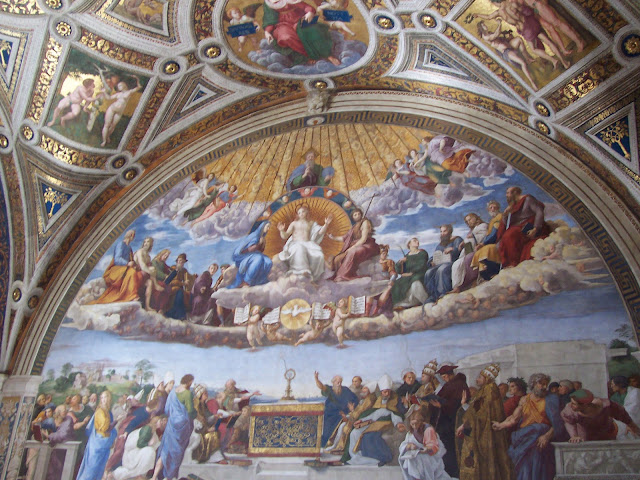
Raphael rooms at the Vatican


View from the Necropoli at Tarquinia


Marble floor at Trajan's market


Me and my partner in worldly travels, in front of the Coliseum.

Tuesday, July 19, 2011

Capitol Hill, Roman Style

It was late morning as we headed into the Roman Forum, this time, not merely to traverse it, but to explore its many ruins. In contrast to Trajan's market, which was still mostly empty when we left it, the forum was filling with clusters of tourists. Where we left off from the paved Roman roads, the earth was hard baked and dusty. We explored through the ruins, reading from our printed information about the ruins, listening to the snippets of information we caught from English speaking tour guides, whose colorful, antenna mounted scarves hung in the heat.

Despite being in the heart of such a phenomenal city, the forum fell into serious disuse and disrepair. Earth from Rome's surrounding seven hills filled in and debris covered much. It was not until the start of the 1800's that real excavation of the site began. Today, most of the buildings are merely bits and pieces still standing. Here several columns stand together, there a crumbling wall. But the forum is fascinating to me because of it's density. This was an urban landscape, a real city center. Full of temples, from that of Venus, to the Temple of Castor and Pollux the forum also housed arches commemorating various military victories, buildings used for various governmental purposes, the house of the Vestal Virgins, and the site where Caesar's ashes are believed to have been spread.


From the Forum, where Rome's Emperors ruled, we traveled to the Palatine Hill, where they lived. This place, whose name, if Wikipedia is to be believed is the origin of the very word palace, is a vast hilltop, covered with the scattered remains of gardens, multiple emperor's palaces, and perhaps a few temples. Also on the hill is the museum, housing finds from the surrounding palaces. Not only is the hill's history to be appreciated, but it's views. On one side, it overlooks the forum, on the other, Circus Maximus.


Foot weary and hot from our long day, we sought refuge in the cool darkness of San Francesco a Ripa. Our main reason for visiting was to see the Beata Ludovica Albertoni sculpture by Bernini. This heavily detailed sculpture was definitely worth our short visit.


The next morning, after two amazing weeks, we flew home.

Saturday, July 09, 2011

Trevi and Trajan


The next day we got up very early, well before any self respecting Italian would think of setting his alarm, and headed down to visit the iconic Trevi Fountain. In Rome in September, in the hours after dawn, the air is pleasant and fresh, but still, neither very cool or warm. The city smells of the cobbled streets, and the only sounds are the cooing of doves, and the occasional car. The fountain lies about a mile north of the ancient and heavily trafficked sites of the Colosseum and the Roman Forum, but the fountains manage to attract their fair share of the tourists anyway, despite being a relatively modern attraction. In a city whose history is best measured by millennia, the fountain was completed in 1762, less than 250 years ago.

The fountain draws the tourists for a few reasons, not least of which is that it is rather impressive. The large pool, and the sort of stone waterfall, ensconced with figures of Neptune, his horses and accompanying riders. All of this before a grand white roman styled palace. But there is also the various movies that have feature the fountain, perhaps most famously, La Dolce Vita. And on top of all that, there's the idea that throwing a coin in the fountain guarantees your return to the city, and who would want to miss out on that? But this early in the morning, there was no one else around. It was quiet and calm, and there was no one there but us to see us toss our coins in


From the fountain of Trevi, we traveled on to Trajan's Market. The site had just opened up for the day, and we were the first to get out and explore the streets and buildings of this former downtown Rome. The buildings are bare walled and empty floored. Unlike Pompeii, there are no relics to indicate whether this might have been a bakery, that a shop, here a tavern. But, there are discoveries to be made. This stairwell leads from a set of shops on a round plaza, up and behind, to a second level street, also lined with buildings. Here, a stone cover conceals the drainage below the street. Over it all are remnants of residences. Prime real estate then, as it would be now.


Now with the day in full progress, we turned from the business of Rome to it's governance, as we made the short walk to the forum.

Wednesday, June 29, 2011

What Lies Below: Capuchin Monks and Necropoli of Tarquinia

After spending time in the beautiful Protestant Cemetery we headed to a different corner of the city to see how the Capuchin monks are interred at Santa Maria della Concezione. Here grotesque art lines the walls and ceilings. Human bones, those of devout former Capuchin monks, form the mosaics. But the effect, despite the material of their construction, while austere and solemnifying, is not at all repulsive. It was with great interest that we peered at each room, inside a rather unassuming looking building. They asked us not to take pictures, and we obliged, but you really have to see it for yourself anyway.

We then headed north out of Rome to visit the Necropoli of Tarquinia. We arrived in the late afternoon, and had the place nearly to ourselves. Tarquinia is the site of an Etruscan cemetery, where each of the tombs date from around the 6th and 7th centuries BC. Each tomb consists of a room carved out of the rock of the hill. a winding path leads from tomb to tomb, descend a set of steps through a little stucco entryway, and peer through glass into the rooms painted with nearly Roman figures. The quality and complexity of the murals vary with the rooms age, and show a variety of scenes from Etruscan life.


Before leaving we picked up a small bronze replica statue, like those many Etruscan works we had seen at museums throughout our trip, a memento of yet another culture which once inhabited this country. We returned to Rome for an early start on our last day in Italy.

Sunday, June 19, 2011

Ancient Ruins Modern Remains

After seeing what Vatican City had to offer, we leapt a little further back in time to the Roman era, when we went to visit the Baths of Caracalla. The baths are in relatively poor condition, but the towering bits of wall, and broken fragments of mosaic floor that do remain, are enough to impart the general idea of the scale of these baths, if not their opulence. Caracalla makes the well preserved baths we visited in Pompeii seem quaint, in terms of scale. We wandered the ruins, identifying the various areas of the baths based on the wikipedia information we had. It is hard to imagine, as with the Coliseum, the marble walls and various decorations which must have once covered the bare brick that remains today. What is even more difficult to grasp in my mind is the engineering complexity of the baths. I want nothing more, after seeing the ruins, than to see a functioning replica of one of these baths. Preferable life size, but a scale model would do.


From Roman times back to the future, and a visit to Rome's Protestant Cemetery was next on our todo list.  The cemetery is easy enough to find, thanks to the prominent Pyramid which marks the grave of Caius Cestius, which well predates the Protestant Cemetery having been built around 15 BC. The Cemetery is all surrounded by a wall,

and through the gate is a surprising green landscape scattered with headstones of every type. Lounging in the pools of light amidst the greenery and blooms, was the odd cat, another sanctuary. The whole place has the feel, not of a burial ground, but of some secret garden. After the hordes of tourists at the Vatican, this place was purely abandoned. We had it to ourselves.


Besides a few interesting headstones, and the beautiful mourning angel, the cemetery is most well known for two of its residents, and their sidelong buried friends. The first of these is Percy Bysshee Shelley, who's wife penned Frankenstein, and who himself was an accomplished poet. My own favorite poem of his, and probably the best
known, is Ozymandias. He lies buried next to Edward John Trelawney, whose name I only noticed at the time because of one of Harry Potter's professors. But, as it turns out, Trelawney was a friend of Shelley, and when Shelly died in a boating accident in Italy, Trelawney was at the cremation, and took Shelley's heart, to give to Mary Shelley which she kept in a box until her death.

In a corner of the walled cemetery is the grave of John Keats, with its famous epitaph "Here lies one whose name was writ in water", but that's not all there is to the story. A friend of Keats, who was there with him through the final stages of his tuberculosis, abided by Keats's wishes by placing the epitaph , but not Keats's name on the tomb. This man, Joseph Severn used a sort of loop hole in Keats's dying wishes, and wrote a good deal more on that headstone instead. In full, it reads: This Grave, contains all that was Mortal, of a YOUNG ENGLISH POET, Who, on his Death Bed, in the Bitterness of his Heart, at the Malicious Power of his Enemies, Desired these words to be Engraven on his Tomb Stone Here Lies One Whose Name was writ in Water. Feb 24th 1821. That same year, Percy Shelley, a friend, wrote Adonais in honor of Keats. But still, the story does not quite end there. In 1879, Joseph Severn died, and was buried next to Keats. As a final  honor to the dead poet, Severn's tombstone names the young English poet he is buried next to. Severn's inscription begins: To the memory of Joseph Severn, devoted friend and death-bed companion of John Keats, whom he lived to see numbered among the immortal poets of England.

Sunday, May 29, 2011

Vatican Museum concluded

After shuffling out way out of the Sistine Chapel, we wandered another long hall back to the main body of the museum, this one filled with various religious architecture. Finally we found are way to the Pinacoteca, the Vatican art gallery. The rooms are ordered chronologically, and the works are almost strictly of a religious nature, whether they be grand paintings of biblical scenes or representations of  the various saints. The works range from the 12th to the 19th centuries and include several works by Raphael, the most impressive of which is The Transfiguration whose vivid colors shine in a dark room. Among the other authors to be found here are Giotto, Bellini, Caravaggio, Titian, Guido Reni, Bernini, and an unfinished St. Jerome by da Vinci.  Also of interest, though the name is less well known to me, is Adam and Eve in the Garden of Eden, by Peter Wenzel, which shows a rather whimsical scene with flora and fauna from the world over.

The Transfiguration

Adam and Eve in the Garden of Eden


From the Pinacoteca, we wound our way through the Pio-Clemento museum. Roman statues peered down at us from crimson niches, as we shuffled past, circling the roman mosaics set in the floor, cordoned off by velvet ropes, and finally into the octagonal courtyard, filled with still more roman sculptures.


After the courtyard we moved into the Egyptian Museum. This museum contains a decent collection of hieroglyph marked stelae, Egyptian statues,  a few mummies, and some bronze votives. Of these, the statues and busts were the most impressive, several good quality pieces as well as a few very interesting pieces that show the Romanization of Egyptian gods, such as the toga adorned Anubis. Of particular interest to me where the final rooms of the exhibit which were not Egyptian, but which contain tablets written in cuneiform, the oldest of all writing forms , and also Assyrian artwork.


Finally, were were done with the museum, and ready to head to the Vatican itself. So we exited by the famous double helix staircase, whose two spirals once allowed guests to both enter and exit this way, but now it is used only as an exit.

Thursday, May 19, 2011

Vatican: Il Museo


After returning to Rome for the final time on our trip, we knew we had to get up pretty early to beat the lines to the Vatican Museum. By the time we arrived, there was already a significant line, and it took us some time after the museum opened to reach the doors. In the mean time, we were glad to have a bottle of water, and no small degree of patience. The wait was formed of a thick line of people who wound their way along the sidewalk around the outside of the walled Vatican City. Passing along the lines were vendors selling scarves and water, and even a few beggars. One particularly shaky elderly woman was so bent with osteoporosis that she walked completely bent over, pitching forward on her cane with every unsteady step. Her condition was thrown into doubt however, when she happened to turn her ragged shawl covered head and reveal a surprisingly young and healthy face.

Once at the gate, we purchased our tickets. The Vatican only accepts cash, despite theme park priced admission costs. Through the gate, We began our journey to the primary site. Down a gilded and painted hallway, we worked our way, shoulder to shoulder with a throng of people. Here and there, telescoping antennas, without there cars or radios, extended into the air, bearing scarves of every possible pattern and color, marking the pirates of these human seas: tour guides. Shouting above the din of shuffling feet and rustling clothes, they tried, seemingly in vain, to point out details in the artwork hanging here and there on the wall along the way, their languages nearly as varied as their scarves.

This hallway, filled to the absolute brim with people from the world over, was the Gallery of Maps. Every square inch of its surface decorated. All along its length were hung, not surprisingly, maps. Finally were poured out into the Raphael rooms. Here, you will find that many do not pause. Raphael seems like nothing, when there is Michaelangelo's Sistine Chapel just ahead. But do not let your anxious interest hurry you here. There are four rooms painted by the artist and his school.
The first of these is the Room of Constantine, named for the first Christian Roman Emperor. While one wall is busy with scenes of war, the ceiling bears the simpler work of another author, Tommaso Laureti, and shows a statue of a Roman god, knocked from its pedestal and lying on the floor, replaced by a golden cross. The next room in the Room of Heliodorus, which depicts another scene of battle, as well as scenes with the namesake of the room, Saint Peter, Moses, Noah, and others. The Room of the Segnatura is a Hall of Fame of sorts. It is one of Raphael's most famous frescoes,
and certainly my favorite of the Raphael  rooms. The Disputation over the Most Holy Sacrament is a whose who of Christian figures, both from the Bible, and saints. On the wall opposite, School of Athens shows many great thinkers from Aristotle to Euclid, each with their own signs to help tell who they are, such as Ptolemy holding a globe. Among the other figures present on the other walls are popes and cardinals, with Dante and Virgil gazing down from the ceiling.


The fourth and final room is Room of the Fire in the Borgo, which depicts several historical events on its walls, including the namesake fire.

Finally, after somewhat more spacious time spent with Raphael, it is time to once again go shoulder to shoulder with the crowds to see the great Sistine Chapel. Here, no pictures are allowed. Here, talking is prohibited.

Here, it is hot, and crowded, the air pervaded by a general murmur from the people, occasionally overridden by a harsh sshhhh! from the security. People snap photos anyway. Protected by the masses. We did take one discreet, rather blurry picture, no flash. Above, is that classic scene, hand reaching for hand. But all around it, on every surface, as with all the other rooms so far, there too is work. But this room is impossibly large. This room is long and tall. The perspective is worthwhile, but without the ability to move about the room and examine it, it is not enough. If I were to visit again, I would wait for some weekday, some cold day, some rainy day. Some day where maybe I might have it more to myself.

To be continued Thursday.